
Your
Trusted
Get Fully AWS Funded
Cloud Migration
Cloud Migration

AWS disaster recovery is the planned ability to restore a workload after a major disruption. It brings together data recovery, infrastructure, access, traffic routing, dependencies and operating procedures. The design should match the recovery objectives for the workload.
RTO is the maximum acceptable time to restore a service. RPO is the maximum acceptable amount of data loss. For example, a workload with a four-hour RTO and a 15-minute RPO must restore service within four hours and retain all but at most the last 15 minutes of committed data.
Backups are necessary for many recovery strategies, but they are not a complete plan. A team also needs a tested way to restore the right data, rebuild or activate infrastructure, obtain access, handle dependencies, route traffic and validate the recovered service.
The appropriate cadence depends on workload criticality, change frequency and business obligations. Test after material architectural changes and often enough to detect drift in the recovery path, access model, dependencies and runbook.
No. Multi-Region designs add cost and operational complexity. The decision should follow the workload’s RTO, RPO, business impact and the type of disaster it must tolerate. For many workloads, a well-tested backup and restore strategy or another active/passive pattern is more proportionate.
An AWS disaster recovery plan earns trust when it turns expectations into a sequence that people can execute and measure. Start with the workloads that matter most, agree the acceptable downtime and data loss, choose the least complex strategy that meets those targets and test the full recovery path. That work gives engineering teams a more defensible basis for investment and gives business owners a clearer view of the risk they are accepting.
A service outage becomes harder to manage when the team has not agreed what “recovered” means. Product, engineering, operations and leadership may all have a different answer. One person expects the service back in minutes; another assumes that restoring yesterday’s data is acceptable. An AWS disaster recovery plan makes those expectations explicit before an incident forces people to make decisions under pressure.
“Disaster recovery starts with business impact. The technical design follows from the acceptable downtime and data loss for each workload, then becomes credible through a recovery path that has been exercised. This article explains how to make those decisions, choose a proportionate AWS strategy and test whether the plan can work in practice.”
Disaster recovery is the ability to restore a workload after a major disruption. It covers the data, application infrastructure, access controls, dependencies, traffic routing and operating procedures needed to resume service. It is related to availability, but it is not the same thing. High availability reduces the impact of more common component failures and routine faults. Disaster recovery addresses events that exceed the normal failure model, such as a regional disruption, destructive data event or a failure that leaves the primary environment unable to serve the workload.
That distinction matters because a workload can be highly available inside one AWS Region and still need a separate recovery decision for a wider event. AWS guidance separates day-to-day availability from the recovery strategy used after a disaster. A useful plan therefore begins by defining the scenario it is intended to handle, rather than treating every resilience measure as interchangeable.
One design rarely fits an entire product. A customer-facing payments service, an internal reporting tool and a data pipeline may all run on AWS, yet the effect of their unavailability can be very different. The payments service may interrupt revenue and customer activity within minutes. The reporting tool may have a larger recovery window. The data pipeline may need a tight limit on lost records even when a short pause is tolerable.
Make the decision with the people who understand those consequences. For each workload, document the service owner, dependencies, user impact, acceptable downtime, acceptable data loss and any contractual or regulatory obligations. This turns “we need disaster recovery” into a set of decisions that engineers can design and test.
Recovery time objective, or RTO, is the maximum acceptable time to restore service after a disruption. Recovery point objective, or RPO, is the maximum acceptable amount of data loss measured in time. If a service has an RPO of 15 minutes, the business is saying that losing more than 15 minutes of committed data is unacceptable.
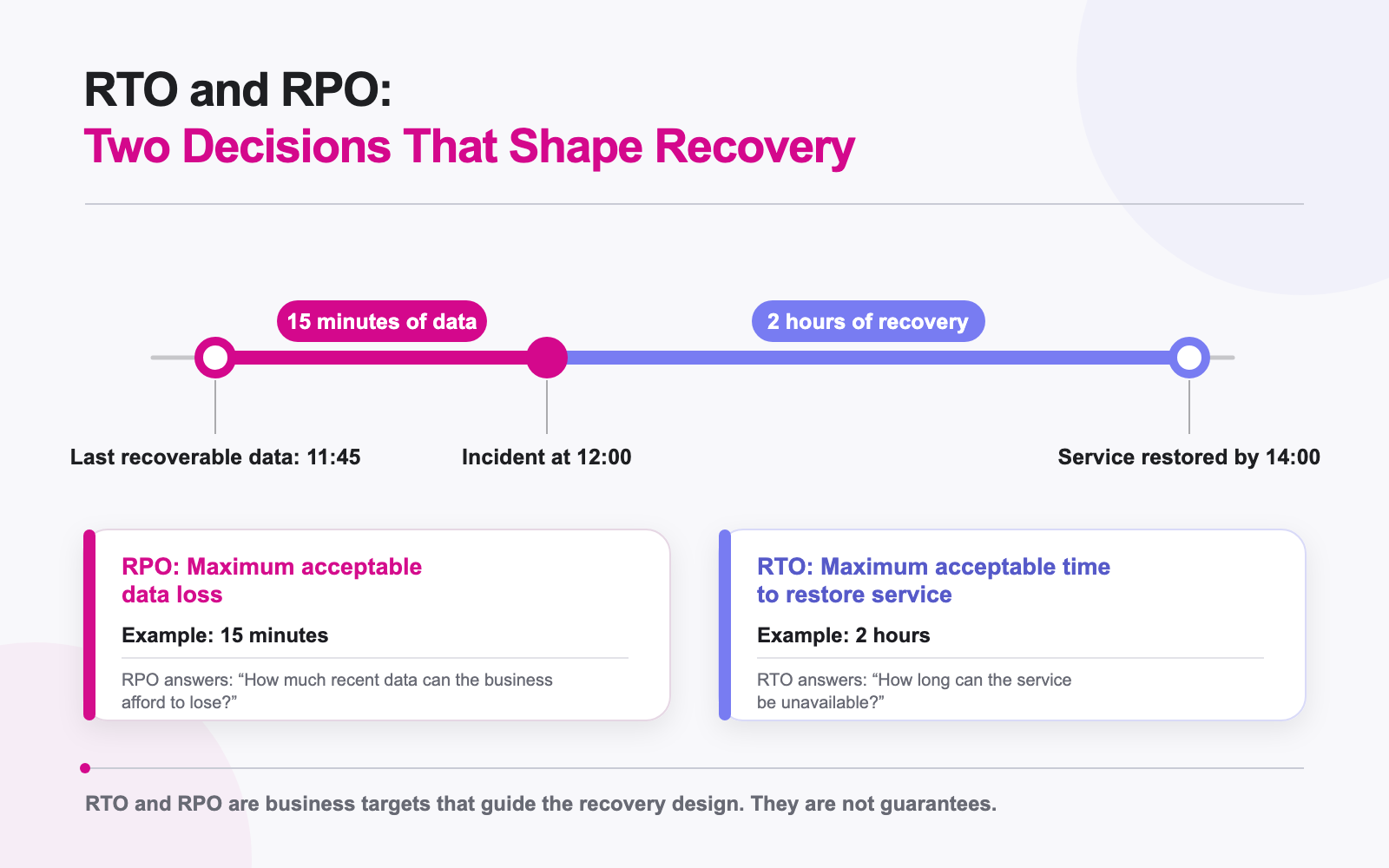
These targets are business decisions that influence architecture, process and cost. A short RPO can require more frequent backups or continuous replication. Recovery-objective is useful because it keeps the conversation grounded in downtime and data loss, rather than starting with a preferred service or architecture.
The common recovery approaches are backup and restore, pilot light, warm standby and multi-site active/active. The right choice depends on the recovery objectives, workload criticality, operational complexity and ongoing cost.
Backup and restore is often appropriate when a workload can tolerate a longer recovery time. The team restores data and redeploys the infrastructure, configuration and application code. That last part is easy to underestimate. AWS recommends infrastructure as code so that a recovery environment can be rebuilt predictably instead of being recreated from memory during an incident.
Pilot light keeps the critical data and selected core elements ready in the recovery Region while application capacity is started or scaled during recovery. It reduces some recovery time and cost compared with a fully running secondary environment, but it introduces a dependency on the steps required to make the application production-ready.
Warm standby keeps a scaled-down but functional version of the workload running in the recovery Region. It can reach a shorter RTO because more of the recovery path already exists, but it also carries a higher ongoing cost and requires the team to keep application and infrastructure changes aligned across both environments.
Multi-site active/active runs workloads in more than one Region and serves traffic from each. It can support the tightest recovery objectives, but it increases design and operating complexity, especially around data consistency, routing, deployment and testing. It is not a default answer. A multi-Region approach should follow an explicit need to protect against a regional event or meet a business requirement that simpler designs cannot satisfy.
Backups matter, but backups alone do not tell a team how to restore a working service. A recovery path includes the data and its restore point, infrastructure definitions, application artefacts, network and identity access, DNS or traffic-routing decisions, external dependencies and a runbook with owners and decision points.
Infrastructure as code helps reduce drift between the primary and recovery environments. So does operational visibility. Teams that manage monitoring checks as code can review the alerts and health signals they will depend on during an incident.
The goal is to make the important sequence visible and repeatable before the failure occurs.
The runbook should answer practical questions: who declares a recovery event, who has authority to change routing, which dependencies must be checked first, which data validation proves the restore is usable and when can the service be declared recovered? Keep the runbook close to the systems it describes and update it when architecture or ownership changes.
A documented plan becomes operationally credible when the team rehearses it. AWS Well-Architected guidance recommends regularly testing failover to confirm that the recovery site works and that the agreed RTO and RPO are met. A useful test starts with a defined scenario and ends with measured evidence: time to restore, data point recovered, steps that required manual intervention, dependencies that delayed the process and improvements to make before the next exercise.
Testing should also include people. An automation may succeed while the decision path remains unclear, or a technically correct failover may still fail to restore a customer journey because a dependency or traffic-routing step was missed. Google’s incident-management guidance is a helpful complement: recovery procedures need clear roles, communication and rehearsed operational response.
There is no universal testing interval. The cadence should reflect workload criticality, change frequency and business obligations. Test after material architectural changes, and treat recurring exercises as a way to find drift while it is still safe to fix.
Recovery readiness spans architecture, operations and evidence for leadership or enterprise customers. Das Meta can help teams assess recovery expectations, turn RTO and RPO into design decisions, plan failover work and improve the operating evidence around a recovery process. This work can sit alongside cloud infrastructure management and monitoring and on-call support, while a deeper recovery-design or failover-testing scope should be assessed against the workload’s actual business requirements.
The sensible first step is a focused review of the workloads that would cause the greatest business impact if they became unavailable. That produces a clearer decision than starting with a generic multi-Region project.