Your
Trusted
Get Fully AWS Funded
Cloud Migration
Cloud Migration
AI can speed up drafting, research and routine analysis, which are tasks that once gave junior people repeated exposure to how experienced colleagues reason. Companies need deliberate ways to preserve that learning through real workflows, review and feedback.
In-person time can support observation and feedback, but it is not sufficient on its own. Teams also need mentoring, live review, clear ownership and protected opportunities for junior colleagues to practise judgment.
Tool fluency matters, but it should be paired with source evaluation, domain knowledge, communication, escalation judgment and the ability to explain why an output is or is not suitable for a decision.
Choose one recurring workflow. Define the approved data and tools, identify the decision a person remains responsible for and create a short review loop where experienced and junior colleagues can compare reasoning and improve the process.
A quieter workforce question is taking shape inside businesses adopting AI:
"If routine work once taught people how the business operates, where will early-career professionals build judgment?"
The question surfaced again in the recent discussion around EY encouraging junior consultants to spend more meaningful time with colleagues in person. EY's message focused on development. It did not announce a formal change to hybrid policy. As AI takes on a larger share of research, drafting and other repeatable work, firms need a stronger answer for how people learn to read a client situation, challenge an assumption and explain a decision.
This is the heart of the AI skills gap. Teams need people who can use AI fluently and evaluate its output in context. The work calls for AI literacy, domain knowledge and confidence with human judgment.
For years, the early stages of professional work depended on repetition. Junior analysts checked source material, assembled first drafts, prepared research and watched more experienced colleagues turn uncertain information into a recommendation. The work could be slow, but it created a practical apprenticeship.
AI is changing that learning path. PwC's 2026 AI Jobs Barometer found that entry-level roles exposed to AI were seven times more likely to require traditionally senior skills such as judgment and leadership. Those roles grew 35% from 2019, while other entry-level roles declined by 10%. The same research found that jobs requiring specific AI skills grew 69%, compared with 9% for the total jobs market.
That does not mean junior people have become less valuable. It means their role is changing earlier. A junior analyst can now use generative AI to produce a strong first pass in minutes. What creates value is checking the source, recognising a missing constraint, asking the next question and knowing when an answer should not be sent yet.
That is where artificial intelligence skills meet judgment. A good answer is not only technically plausible. It must be useful, appropriate and defensible in the context of the business.
There is a fair argument for more deliberate time together: people learn difficult professional behaviours through observation and feedback. A junior consultant who hears a colleague reframe a difficult client question, or sees an experienced manager pause before making a recommendation, learns something that is rarely visible in the final document.
These moments are difficult to package into a one-hour generative AI course. The human skills in the age of AI include listening, presentation, negotiation and the ability to create trust with a client or colleague. Artificial intelligence and emotional intelligence sit side by side in that work.
One helps teams process information. The other helps people understand when and how to act on it.
Proximity can help. It is not a complete answer. A team can be in the same room every day and still leave judgment implicit. It can also work across locations if managers make the learning moments visible, explain their reasoning and give junior colleagues safe opportunities to practise.
This matters especially for AI adoption in professional services, where the work can involve confidential information, high client expectations and decisions that need a clear owner. Moving people back into an office does not define which work AI may support, who reviews an output or how a team decides whether the result is good enough.
This is where many AI adoption programmes become fragile. Teams buy tools, create an acceptable-use policy and expect capability to emerge. The Thomson Reuters Institute's 2026 AI in Professional Services report shows the gap clearly: 40% of professionals said they had received conflicting instructions about using AI on client work, depending on the client. Only 18% said their organisation collected AI return-on-investment metrics, while another 40% did not know whether those metrics were collected.
The gap spans skills, systems and leadership. AI workforce training cannot stop at tool access or a policy document. People need to know what the tool can do, when its output needs challenge and how responsibility stays with the team.
OECD research on AI and skills points to a similar constraint: many businesses, especially small and medium-sized enterprises, say that a lack of people with the right skills limits their ability to use AI.
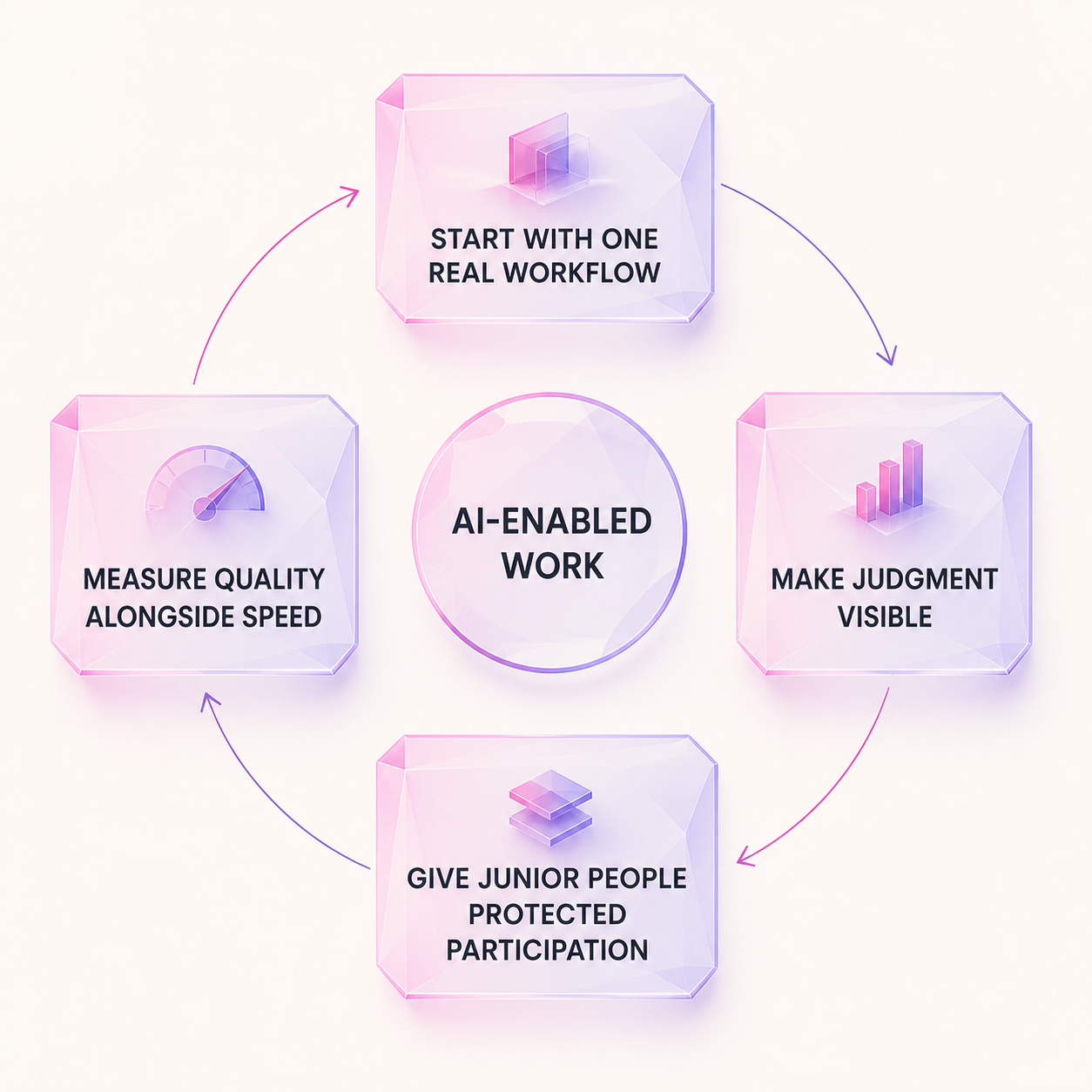
A practical learning loop for AI-enabled work.
Leaders can build a stronger model through short, recurring learning loops inside real work.
The technical foundation matters too. An AI capability layer should give people appropriate access to approved tools, clear traceability and defined approval points. Those controls do not replace judgment. They create the conditions in which it can be learned and applied responsibly.
This is also why the cost of a weak learning model rises quickly. When teams use AI without clear workflows, they can create duplicated effort, inconsistent quality and avoidable infrastructure spend. The hidden infrastructure costs of production AI show why adoption needs both capable people and an operational foundation.
The question for leaders is not simply whether AI will remove junior work. It is whether the organisation is redesigning that work into a path where people can still learn to make sound decisions.
The answer should include more than technical fluency. It should also include context, client judgment, decision quality and responsibility. Companies that treat AI adoption as a workforce design issue will have a stronger chance of building durable capability.