
Your
Trusted
Get Fully AWS Funded
Cloud Migration
Cloud Migration

Start when there is still time to change the conditions that a test exposes. For many teams, that means agreeing critical journeys and dependencies several weeks before the campaign, running representative tests early enough to address findings, then tightening change control closer to the peak.
Autoscaling addresses only the workloads it can scale. Constraints can still remain in databases, third-party payment services, inventory systems, queues or custom integrations. Readiness comes from matching capacity choices to the actual dependencies in a customer journey.
Use a focused set tied to the critical path: availability and latency for storefront and checkout, payment authorisation outcomes, order-confirmation delay, stock-reservation failures, queue depth and the rate at which support contacts rise. The right thresholds depend on the platform and its commercial commitments.
No. The model should reflect the platform’s exposure and complexity. A small, largely hosted store may need a concise escalation list and a targeted checkout test. A platform with large campaigns, custom services and multiple external dependencies may need a more explicit operating room.
The useful contribution is operational clarity: dependency mapping, observability, capacity analysis, test design, incident ownership and a review of the changes that could add risk during the event. It should help the internal team make informed decisions while retaining the team’s knowledge of its customers and commercial plan.
Black Friday is often discussed as a marketing event, but for the team running a production e-commerce platform, it is a concentrated systems event: a sudden change in demand that moves through storefronts, search, inventory, checkout, payments, customer support and the people responsible for making decisions when something slows down.
The scale is visible in German data. On Black Friday 2025, online order volume was 106% above a normal Friday. Each shop needs its own traffic model and capacity assumptions. It does make one point difficult to ignore: the gap between a normal day and a promotion day can be large enough to expose dependencies that appear stable for the other eleven months of the year.
Readiness is therefore less about provisioning a generous amount of compute and more about knowing which parts of the customer journey carry the operational risk, what will happen when one dependency degrades, and who can make a call without opening three parallel incident channels.
"A traffic peak shows whether a platform can turn signals into decisions."
The commercial stakes are real: the 2025 Black Friday and Cyber Monday period in Germany was expected to generate €5.8 billion in sales, while 48% of surveyed shoppers said they planned to buy discounted products on Black Friday. A large campaign can send people to a platform within minutes. For the platform, the moment arrives as concurrent requests, cache pressure, connection pools, queue depth, payment authorisation calls and a surge in support tickets.
This is where broad “can we scale?” conversations become too vague. A commerce platform can have elastic web capacity while a payment callback, stock-reservation service or product-search integration remains the real constraint. It can also tolerate page-load pressure while failing at the point where customers commit to an order. The critical question is specific: which customer actions have to remain observable and controllable under load?
The operational priority should follow the path a customer takes, rather than the order of infrastructure dashboards. In German online shopping, payment options, delivery and security or trust are considered very important by 54% of shoppers. These are customer expectations, yet each one maps to a technical dependency: payment providers and risk checks, carrier and fulfillment integrations, identity and fraud controls, and the data flows that keep product, order and delivery states consistent.
A useful readiness review starts by naming the journeys that matter during a peak:
A useful readiness view gives the team a shared account of platform behaviour before commercial and technical signals drift apart.
Autoscaling is valuable when it matches the workload. It cannot correct a slow downstream API, a saturated database path, a queue that lacks consumer capacity or a payment provider that is rejecting calls. In a peak, more application instances can simply reach the same constrained dependency faster.
That is why e-commerce scalability needs a dependency map that is practical enough to use under pressure. For each critical path, record the entry point, the services and data stores it touches, the external calls it relies on, the signal that shows it is degrading and the person or team able to act. This turns a vague escalation rule into a controlled operating decision.
The distinction matters for costs as well. Permanent overprovisioning may be an acceptable choice for a small, stable workload with a clear seasonal profile. It becomes expensive and misleading when it masks an architectural bottleneck. Capacity should be added where it changes the outcome, after the team knows which dependency is actually limiting the journey.
During a traffic peak, alert volume can become its own failure mode. Infrastructure metrics still matter, while customer-path signals show whether customers can complete a purchase. A readiness view should connect technical signals with the critical paths: checkout error rate, payment authorisation latency, order-confirmation delays, stock-reservation failures, queue backlog and the response from the support flow.
It also needs a small set of decisions agreed in advance. Who can pause a rollout? Who can switch off a non-essential integration? Who is authorised to contact a payment provider? Which alert wakes an engineer, and which alert is recorded for later investigation? Those decisions are part of e-commerce monitoring because they determine whether a signal becomes a useful action.
This is particularly important after a customer-facing failure. When an order confirmation is missing or a delivery status is unclear, 62% of German online shoppers would prefer quick access to a human contact. A support team cannot provide that clarity if the platform has no reliable record of what happened across payment, order and fulfilment systems.
Checkout testing calls for a representative model. A more representative test combines realistic browsing behaviour with moments of concentration: a campaign landing page, a bestseller going out of stock, a payment timeout, a delayed tax calculation or a carrier integration that returns slowly. The relevant question is whether the customer receives a safe, understandable outcome.
Payment mix is one reason to be specific. In German e-commerce, PayPal represented 28.7% of online-payment revenue share in 2025, purchase on invoice 26.1%, direct debit 14.4% and credit or international debit cards 13.7%.
Each method follows its own route through the checkout stack, with different provider dependencies and response-time expectations; the mix gives the platform team a practical indication of which paths deserve the closest capacity testing, traffic volume and the design of the checkout still determine the actual load profile.
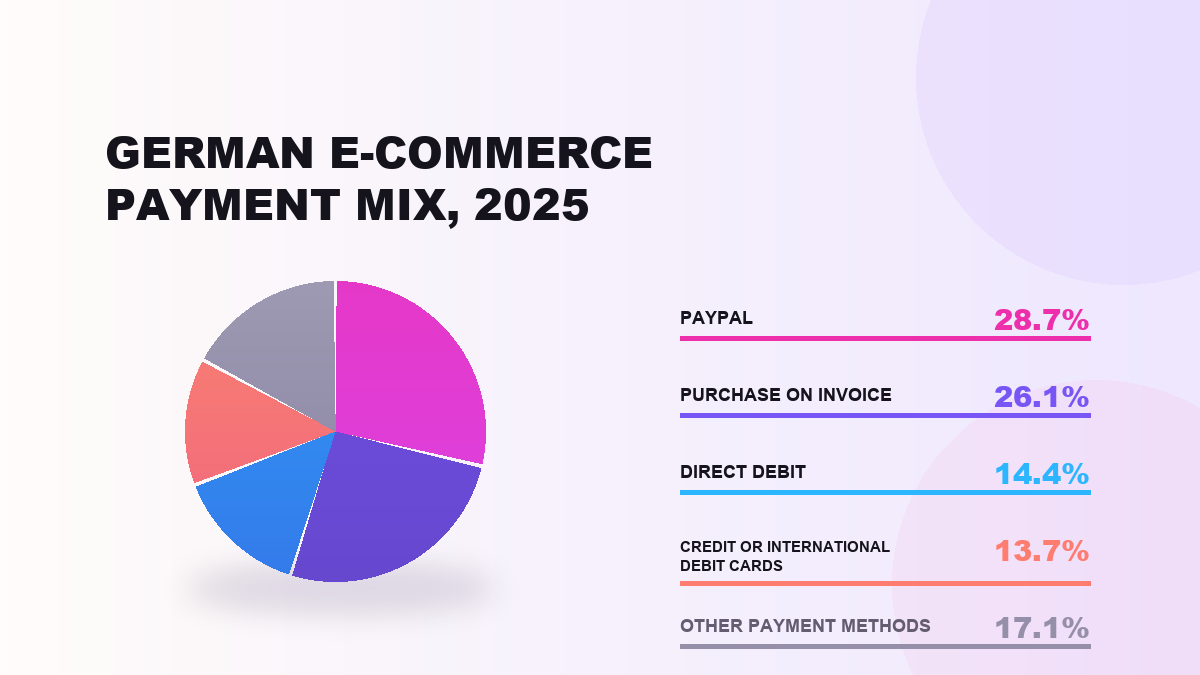
German e-commerce payment mix by online-payment revenue share, 2025.
Let’s make an example: consider a customer attempting to pay by card during a Black Friday rush, when a delayed response from the payment gateway leaves the browser waiting just long enough for the customer to refresh the page or submit the order again; the original request may already be moving through payment authorisation, stock reservation and order creation. Idempotency controls, queue visibility and sufficient capacity across those services keep that sequence traceable, so that a completed payment does not later surface as duplicate orders or conflicting inventory records. Testing the payment methods, fallbacks, retries, asynchronous confirmations and reconciliation paths used by the actual customer base gives cloud infrastructure management a concrete operating role during peak traffic.
Tests also need an exit criterion. “We ran a load test” is an activity; a stronger statement is: the team tested the agreed customer journeys at the chosen traffic profile; the observed constraints are documented; named owners accepted or mitigated the open risks; and the rollback or traffic-control options were rehearsed.
Peak governance should match the real exposure of each commerce team. A small store on a mature hosted platform, with limited promotion exposure, few custom integrations and a predictable sales pattern may gain little from a large incident room or complex synthetic test suite. The operational overhead can cost more than the risk it removes.
The useful principle is proportionality. Start with the real exposure: the size and timing of the campaign, the customer journeys that generate orders, the custom services around them, the external dependencies and the team’s ability to diagnose a failure. Add structure only where it shortens uncertainty or gives a clear decision path.
For teams with meaningful peak exposure, a focused review can be completed without turning October into an architecture rewrite:
A dependable operating model replaces a hopeful capacity plan with a view of where pressure is building and what the team can do next.
A comparable lesson emerged when 15x more traffic than expected hit our client after a TV campaign: capacity was only part of the situation. Workload placement, autoscaling behaviour and monitoring all shaped the response. The details will differ across platforms, but the discipline carries: test the conditions that make your own demand pattern unusual, then make the resulting decisions visible before the campaign begins.
If a readiness review reveals unclear ownership, invisible dependencies or a capacity plan that cannot be explained, that is a cloud-management question as much as a Black Friday question. A stronger operating foundation gives engineering, operations and commercial teams a shared view of what the platform needs during its most demanding window.