
Your
Trusted
Get Fully AWS Funded
Cloud Migration
Cloud Migration
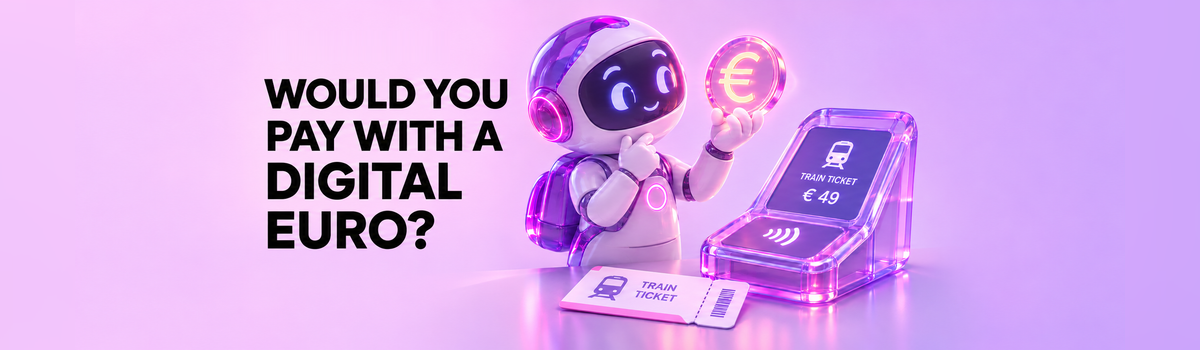
The digital euro would be money issued by the European Central Bank and euro area national central banks for everyday payments. People could use it alongside cash and existing digital payment options.
The ECB plans to start a 12-month pilot in the second half of 2027 with selected payment providers, merchants and central bank staff. A public rollout would require EU legislation and a separate decision by the ECB.
Under the proposed design, a linked bank account could cover a shortfall during an online payment. To make offline payments, you would fund your offline balance in advance.
For online payments, providers would handle the data they need to process the transaction and meet legal obligations. Under the proposed offline design, only the payer and payee would know the personal transaction details.
Start with a payment that clears while the order confirmation fails. Check whether your team can match the records, prevent a duplicate charge and tell the customer when to expect a ticket or refund.
“The ECB has selected 36 payment providers for its digital euro pilot, planned for the second half of 2027. The pilot will test proposed payments before the ECB decides whether to issue a digital euro.”
Imagine you’re in Germany buying a €49 train ticket from a Spanish rail operator. Today, you can pay by card. If the digital euro goes ahead, you might see another option at checkout: Pay with digital euro.
Same ticket, same price. Why would you choose the new button?
For fintech teams, the bigger questions are who controls the payment infrastructure, what transaction data each party can see, and how customers are protected when a payment goes through but a service fails.
European banks are already working on alternatives. Wero lets people make payments directly from their bank accounts through a European service. If enough banks, merchants and customers use it, a network like Wero could offer an alternative to established card networks.
The digital euro would take a different approach. Wero moves money held in a bank account. A digital euro would be central bank money in digital form: a way to use money issued by the central bank for a payment made online or, under the proposed design, offline.
You can already buy a train ticket with cash at a counter that accepts it. A digital euro could let you use central bank money when booking from home.
That distinction matters to the payments system. Whether it matters enough to change a customer’s habits is another question.
Perhaps not. If your bank account is protected by deposit insurance and your card works well, moving money into another wallet may feel like an extra step.
The proposed digital euro would not pay interest. The ECB also describes a way to link a bank account so that, when an online payment exceeds the balance in a digital euro account, the shortfall could be covered from the linked account. That could make a payment possible without keeping a large balance in the wallet. The final design remains subject to legislation and further decisions.
Offline payments offer another possible use: paying when an internet connection is unavailable. Cash still has its own advantage: a banknote works when your phone battery is dead.
A new payment method needs a reason to be useful in the moment someone chooses how to pay.
Privacy may be part of that decision.
For an online digital euro payment, a payment service provider would process information needed to provide the service and meet legal obligations. The ECB says the system would be designed so the Eurosystem could not directly identify users from their payment data.
The proposed offline mode aims for a level of privacy closer to cash: the details of an offline payment would be known to the payer and payee, while a provider could see the funding or defunding of the offline balance. These are proposed features, and the final rules and implementation still matter.
For a customer, the practical question is simple: who can see a payment, under what circumstances, and what can they do with that information?
You select Pay with digital euro. Your wallet shows that €49 has been spent, but the booking page times out. The train leaves in ten minutes.
Can the rail operator find the payment and issue the ticket? Can you retry without paying twice? Who can help if the wallet and booking system show different outcomes?
This is where the pilot becomes interesting for payment providers, merchants and technology teams. Adding a payment button is the visible part. Helping a customer recover when something goes wrong is what earns that button a second click.
A merchant, its payment provider and the customer’s wallet provider may each see a different part of the transaction. They need ways to reconcile those views, investigate failures and give the customer a clear next step.
For fintech teams, a new payment method creates work across product design, integration, operations and customer support. The experience depends on more than whether a payment can be initiated: teams also need to understand pending transactions, failed confirmations, refunds and disputes.
The ECB pilot is intended to test a beta version in controlled real-life situations. Its results can inform the preparation work, but participation in the pilot does not mean a digital euro has already been approved for issuance.
At Das Meta, we help technology teams build and operate cloud infrastructure for digital services. Our guide to AWS RDS monitoring for FinTech discusses signals teams can use to investigate slow data workflows, while our cloud infrastructure management service covers reliability, security and ongoing operations. See how we support fintech cloud infrastructure behind transaction processing, reporting and partner integrations.
A merchant may already accept cards, bank transfers and digital wallets. Each option brings integration work, payment processing costs, support questions and another set of transaction records. A new method therefore has to fit into the business as well as the checkout page.
For a company selling across borders, a payment option designed for use throughout the euro area could make a common customer experience easier to imagine. But the actual benefit would depend on the final rules, provider services and the work needed to connect existing systems. The pilot can help participants discover where those practical challenges arise.
There is also a question of customer expectation. A buyer who sees a new button may assume that refunds and support work just as they do with a card. The merchant needs to know what information it will receive, how it will reconcile payments, and how to explain the process when a customer asks for help.
Return to the train ticket. A timeout does not necessarily mean that the payment failed. One system might have recorded the transaction while another is still waiting for confirmation. If the customer tries again immediately, the merchant must determine whether there is one payment, two payments or none.
That requires a shared way to identify the transaction, clear status messages and a process for resolving uncertainty. A useful status might tell the customer that a payment is still being checked, rather than inviting a second attempt before the first outcome is known.
Support teams also need a route to investigate. Which provider should the customer contact? What reference can they share? How quickly can a merchant confirm a booking or arrange a refund? Those answers depend on the final payment arrangements, but they are questions teams can prepare to test. Incident reviews should also check whether a restored system can complete the original booking. See our guide to testing AWS disaster recovery for an example of how to validate the full workflow.
Customers may want payment details kept private, while expecting a merchant to find a missing transaction quickly. Designing for both means asking what each participant actually needs to know, for what purpose, and for how long.
An online purchase may require enough information to provide the service and handle a dispute. An offline payment is intended to disclose less to intermediaries. In either case, the customer should be able to understand which organisation can help and what information they may be asked to provide.
The pilot is an opportunity to examine these trade-offs in practice. A system can be technically capable of making a payment and still leave important questions about explanations, recovery and everyday use.
The ECB reports that more than two-thirds of euro-area card-based transactions are processed under rules set by non-European companies. Thirteen euro-area countries depend on international card schemes or mobile solutions for in-store payments. That is the ECB’s case for a European-governed alternative: resilience and strategic autonomy, alongside competition.
Yet independence is not the same as adoption. Existing networks offer acceptance, familiar dispute processes and established integrations. A new public payment rail may improve negotiating power only if enough merchants, providers and customers use it. For fintechs, the question is whether the new rail enables useful services on top of it, and whether the economics justify integration.
A digital euro would be a claim on the central bank. The ECB acknowledges that banking associations, bank-sponsored research groups and scholars have raised concerns about deposit shifts, liquidity and lending. Their estimates depend on assumptions about holding limits and banks’ funding models. The ECB’s summary of the debate explains why these risks remain contested.
The ECB proposes holding limits, no interest on digital euro balances and links to bank accounts to reduce that risk. Its modelling found limited aggregate effects in normal conditions and assessed hypothetical limits up to €3,000, including a severe crisis scenario. That figure is a modelling assumption, not a final limit. Aggregate results can also conceal differences between banks.
A lower holding limit may help contain deposit outflows, though it could make the wallet less convenient. A higher limit may be more useful for customers and could increase outflows. The final limit will set that balance.
In a BIS survey published in 2025, 85 of 93 central banks, 91%, said they were exploring a retail CBDC, a wholesale CBDC, or both. Wholesale work was generally further advanced. Exploration does not mean launch, and retail payments should not be confused with wholesale settlement between financial institutions.
Jurisdictions are making different choices about privacy, access, intermediaries and infrastructure. If systems develop without common standards, they could reproduce today’s fragmentation in a new form. If they become interoperable, they could eventually support more efficient cross-border services, but legal agreements, foreign-exchange liquidity, compliance and commercial incentives would still matter. The digital euro pilot itself is not a promise of instant global transfers.
One scenario is stronger competition between payment networks: a widely used European public rail could give merchants and fintechs another option and influence the terms on which private providers compete. Another is limited take-up, where the digital euro remains available but familiar products continue to dominate. Neither outcome is guaranteed; acceptance, cost, usability and distribution will shape the result.
A third possibility is that public digital money and private services become complementary. Banks and fintechs could use common infrastructure while competing on customer experience, reconciliation, fraud controls and value-added services. Stablecoins are a different proposition: they are privately issued claims and their risks and regulation depend on their structure. Competition between these models could influence how money moves across digital markets, but a retail digital euro alone would not determine the euro’s global role.
For fintech leaders, the launch date is only one question. They also need to consider which payment services become shared infrastructure, who controls access and data, and where firms can build services customers will choose.
If your card, Wero and a digital euro were all available at the same checkout, what would make you choose the digital euro?
The ECB plans to start a pilot in the second half of 2027 with 36 payment providers. Issuance would require a separate decision.
A common payment option across the euro area could give merchants more choice. Its competitive effect depends on how many merchants accept it and whether shoppers use it.
For fintech teams, a payment test should cover what happens after checkout. Can support find a payment that cleared when the order failed, and can the customer recover without paying twice?